 Cloud
Codex · Luna Max
6:04
Coding agent runtime benchmark
Four execution stacks. One repository.
4 patches · all targeted tests passed · 6:04–13:57
Cloud6:04

 Local
8:04
 Cloud
12:54
Local13:57
Captured: 2026-08-21T12:39:07+02:00
OS
Windows 11 Pro
CPU
AMD Ryzen 9 7950X
Cores
16C/32T
RAM
128 GB
GPU / VRAM
NVIDIA GeForce RTX 4090 / 24 GB
GPU driver
610.88
| Run | Runtime | Model | Format / quantization | Context / KV cache | Backend |
|---|---|---|---|---|---|
| Codex · Luna Max (Cloud) | Codex CLI 0.148.0-alpha.21 | gpt-5.6-luna (GPT-5.6 Luna Max) | not exposed by provider | 258400 tokens / not exposed by provider | not exposed by provider |
| DSH · Qwen 3.8 27B (Local) | DeepSeek Harness (dsh) 0.1.0-rc.8 | Qwen3.8-27B-Q4-100K-Q8 (Qwen 3.8 27B Q4 (100K Q8 KV)) | GGUF / Q4 | 100K (102400 tokens) / Q8 | llama.cpp |
| OpenCode · Luna Max (Cloud) | OpenCode 1.18.19 | GPT-5.6 Luna | not exposed by provider | not exposed by provider / not exposed by provider | not exposed by provider |
| OpenCode · Qwen 100K (Local) | OpenCode 1.18.19 | Qwen3.8-27B Q4 (100K Q8 KV) | GGUF / Q4 | 100K / Q8 | llama.cpp |
Hardware was re-verified on the same machine after the runs finished. Per-run values come from the retained session exports; anything not recorded at run time is marked as such rather than guessed.
Weight quantization (Q4) and KV-cache quantization (Q8) are kept as separate figures for the Qwen runs.
Four different patches · every targeted suite passed
The benchmark measured the full execution stack
The model is only one input to wall time and reported token volume.
System prompt, skills, memory and planning policy
Fresh input, cache reads, compaction and continuation
Repository reads, edits, commands and test invocations
User replies, reviewer passes and verification rules
Patch scope, targeted tests and final handoff
Seconds · lower is better
Millions of tokens · not a direct speed score
Direct harness = 1.00 · lower is better
Codex omitted because comparable export counters were unavailable
Percent · fresh input versus cache reads
Seconds · review versus all other measured time
Thousands of tokens · output plus separately reported reasoning
| Runtime | Selected change | Files | Tests | Result |
|---|---|---|---|---|
| Codex · Luna Max | ValueError compatibility plus a non-object flashcard guard | 2 | 11 | 11/11 |
| DSH · Qwen 27B | Atomic RunKeyStore save with a temporary file and os.replace | 2 | 14 | 14/14 |
| OpenCode · Luna Max | FlashcardValidationError inherits from ValueError | 3 | 11 | 11/11 |
| OpenCode · Qwen 100K | OCR whitespace correction for garbage-ratio counting | 2 | 17 | 17/17 |
Four coding-agent sessions received the same repository and the same high-level assignment. Every session produced a repository change and passed its targeted tests. End-to-end duration still ranged from 6:04 to 13:57.
Codex with Luna Max was the shortest observed run. DSH with Qwen 3.8 27B was the shortest observed local-model run. Both OpenCode configurations took longer, even though OpenCode Qwen reported the lowest total token volume.
The central finding is therefore not a universal model ranking. A coding agent is more than its model: system instructions, skills, memory, context management, cache behavior, tools, user gates, review policy and final verification all contribute to the result the user sees.
The four sessions started with the same repository and abstract assignment, but they were not forced to select the same concrete defect. The Luna runs converged on the same flashcard area while choosing different patch scopes. The two Qwen runs selected different defects.
This benchmark compares complete runtime profiles, not four models under a controlled same-patch condition. That boundary matters. A session may take longer because generation is slower, the runtime performs more tool work, reviewers add a second pass, or context compaction and continuation create additional turns.
OpenCode Luna took 2.13 times as long as Codex Luna. OpenCode Qwen took 1.73 times as long as DSH Qwen. At the same time, OpenCode Qwen was the longest session despite reporting the smallest total token volume. Lower token volume is therefore not automatically a speed or quality score.
The token schemas also differ. Codex reports reasoning as part of output. OpenCode exposes reasoning separately and combines fresh input with cache reads in its prompt total. DSH provides prompt and output totals. The normalized numbers are workload signals, not direct billing, energy or subscription-limit figures.
More than 91 percent of prompt-side volume came from cache reads in both OpenCode sessions. OpenCode Luna reported 220,630 fresh-input tokens and 2,451,456 cache-read tokens; OpenCode Qwen reported 145,146 and 1,514,973 respectively.
DSH Qwen used 36 assistant rounds and 57 tool calls. OpenCode Luna used 32 rounds and 67 calls; OpenCode Qwen used 31 rounds and 39 calls. Codex did not expose directly comparable counters in the reviewed export, so it is omitted from that chart instead of being assigned a misleading zero.
OpenCode Luna activated brainstorming, writing plans, test-driven development, code review and verification before completion. The reviewer alone accounted for about 299 seconds, or 38.6 percent of the session. This process can be valuable for a large or risky change. For a small fix, its fixed cost became a substantial part of the run.
Codex Luna used Karpathy guidelines and prior working memory. Those inputs may have encouraged a smaller patch, explicit assumptions and direct verification, but a single run cannot quantify their independent effect. That requires a separate skills-on versus skills-off experimental arm.
Each condition ran once, so there is no variance or confidence interval. The agents did not implement the same patch, token exports use different semantics, and Qwen ran locally while Luna used cloud infrastructure. Test counts are not a quality ranking because the patches covered different behavior.
A stronger next experiment should use one fixed issue, one acceptance test, identical tools and system instructions, and equal context and timeout limits. Every condition should run at least three times. Qwen reporting should include hardware, quantization, context limit, KV-cache format and generation throughput. Per-step timestamps would finally separate model latency from tool and reviewer time.
The measurements were reconstructed from four retained session exports: `lunamax-session.jsonl`, `session.jsonl`, `session-ses_fdda.md` and `session-ses_fdd8.md`.
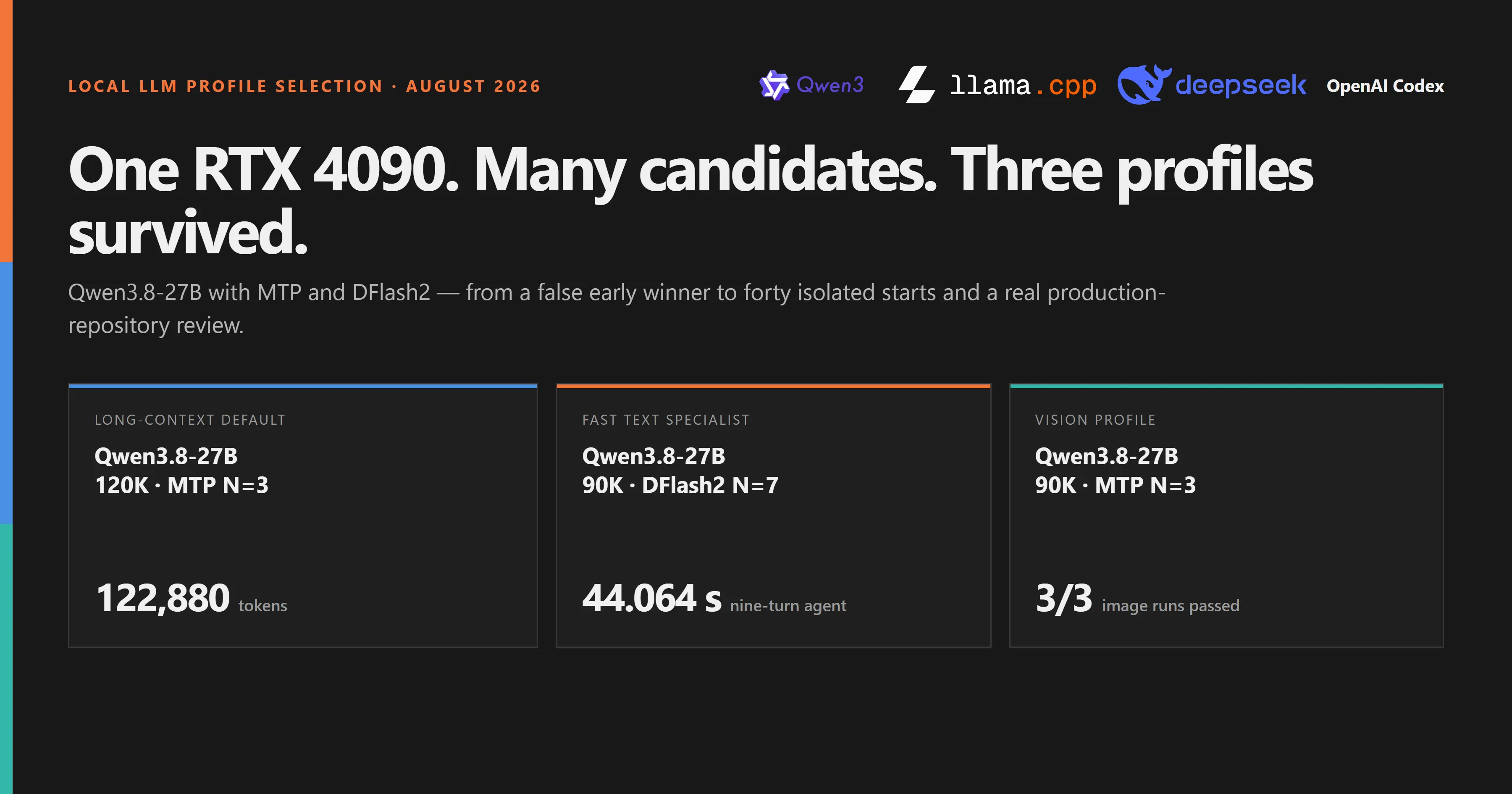
From many candidates to three profiles: Qwen3.8-27B with MTP and DFlash2
On one RTX 4090, MTP and DFlash2 profiles were eliminated stage by stage. The result is not one universal winner, but a 120K MTP default, a fast 90K DFlash2 text specialist, and a verified 90K MTP vision profile.
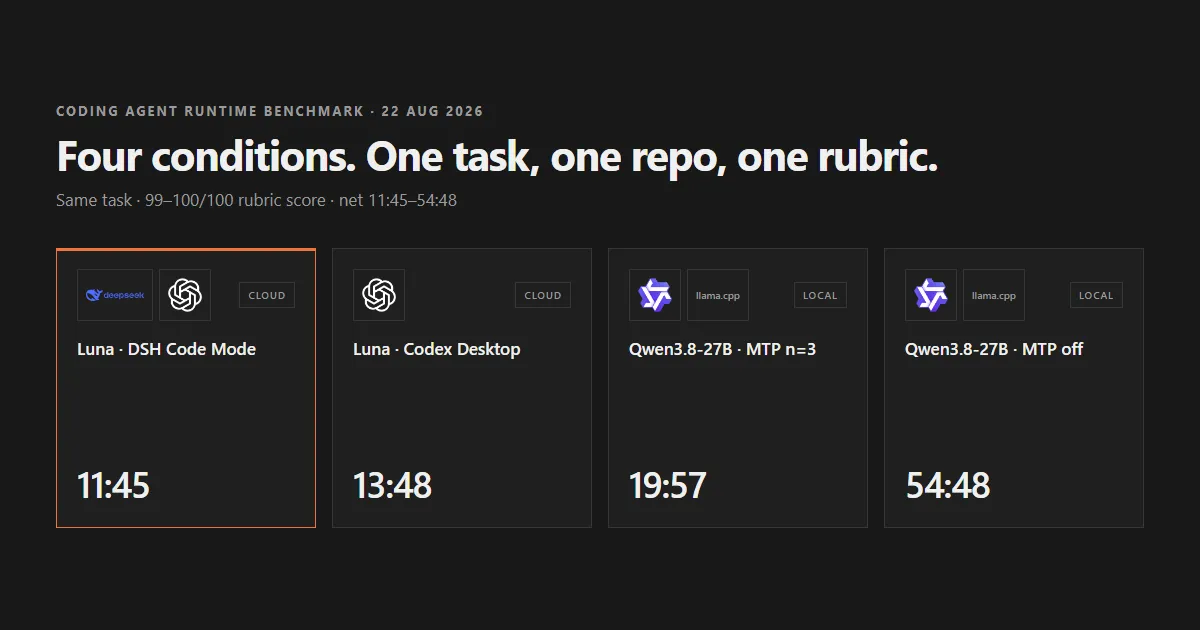
Four conditions, one task: what speculative decoding and your agent tool actually cost
Four conditions solved the identical task in the identical repository and every one scored 99 or 100 out of 100. Net task time — with approval waits and automatic context compaction excluded from every measurement — ranged from 11:45 for the cloud run through DSH standard mode to 54:48 for the local model with speculative decoding off.
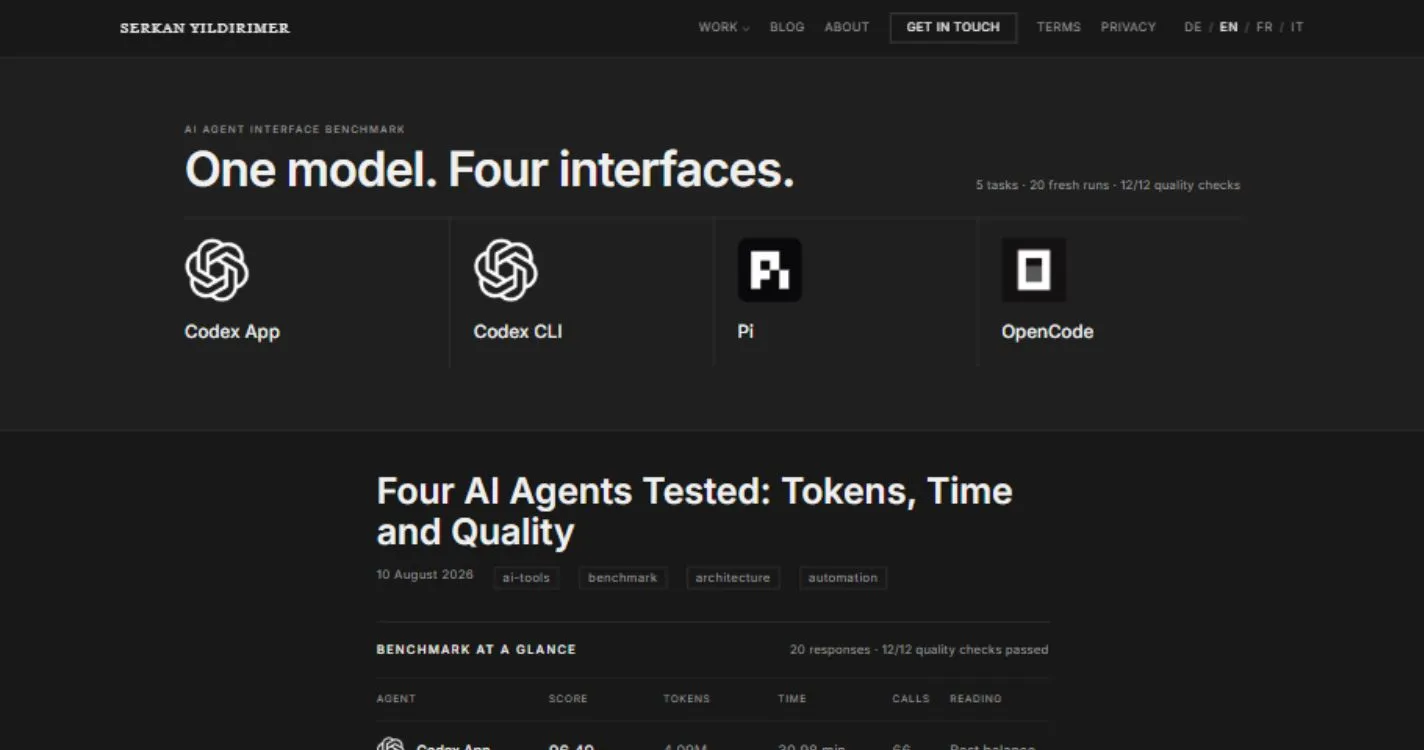
Four AI Agents Tested: Tokens, Time and Quality
The same AI model, four agent interfaces and five real repository tasks: what actually changed in quality, token volume, runtime and working style.